We had been in Shark Bay for 10 days now, and although there were some very beautiful places here, we were ready to move on. The wind had blown incessantly and there were few sheltered anchorages. In fact, we needed to move on, with the weather predicted to get only stronger and more relentless.
Our next stop would be Geraldton, where we could enjoy the comforts of a marina and not have to worry about the winds for a while. Oh, how we were looking forward to that! The issue was that Geraldton lay 180 nautical miles down the coast. A coast that was home to the infamous and treacherous Zuytdorp Cliffs, that stretch almost unbroken for 200 kilometres until Kalbarri. We wouldn’t be able to stop at Kalbarri as the river there is too shallow for Cool Change, so it was all in to Geraldton, 180 miles away, with the only other possible stop being at Port Gregory, 40 miles before Geraldton.
We decided to aim for Geraldton, with Port Gregory as an option, if we needed it. It didn’t look like a great anchorage, but we thought it might be ok in a pinch. From Geraldton, we told ourselves, we could day hop down to Fremantle. Just one last long passage to go. It was a thought that buoyed and sustained us. It didn’t turn out to be true, but that’s a story for later!
Matt had identified a break in the weather that should allow us to get down to Geraldton in time before the next front hit. Not exactly ideal conditions, but safe enough. There was no point waiting for perfect conditions, we’d be waiting forever. Close enough was good enough. Although we’d uummed and aahed, prevaricating for 12 hours, we finally bit the bullet and headed off, confident we’d still manage to make it all the way to Geraldton, or at least Port Gregory.
It was 4.30 pm as we motored out of the sheltered waters in Shelter Bay and up to the heads at Steep Point. I was feeling apprehensive but quietly determined. Matt came over and sat next to me, giving me a big squeeze, ‘We got this,’ he said. Big, big swells greeted us as we emerged out into the Indian Ocean, the boat riding up and down the waves. We angled ourselves so the waves were coming at us from the front and not the side and started heading away from the coastline; we wanted to be miles and miles from those nasty cliffs.
It wasn’t a nice feeling, the boat riding up the swell and then smacking down on the other side. I felt pretty crap. I went to lay down at 6.30 pm, getting up to relieve Matt at midnight. I felt even worse during that night watch in the cold, exposed cockpit and only managed two and a half hours. Matt did another five hour watch, before I relieved him at 7.30 am. Thankfully, I was feeling better by then and as the day progressed the seas calmed and the swell died down. The sun even popped its head out a few times. We were motor sailing with the main up and two reefs in.
Despite running the engine at slightly higher revs, we weren’t going as fast as we thought we would. By midday it was clear, we wouldn’t be reaching Geraldton before dark or before the strong winds arrived. We changed our sights to anchoring at Port Gregory, sitting out the next day there, and then continuing on the last 40 miles.
The wind was starting to build as we cautiously approached Port Gregory, weaving our way through the reef into the narrow little anchorage. Seeing several free mooring buoys around, Matt contacted the caravan park and then a local fisherman and received permission to jump onto one of his moorings. It was a huge relief to be safely in and tied up.
The strong winds came in that evening, as predicted, but we were surprisingly protected and comfortable in the little anchorage, tucked in between the reef and the beach. However, we were concerned many times that the mooring may have been dragging. It was hard to tell. At times it seemed like we were edging worryingly close to a nearby fishing boat, but then we’d swing slightly and seem fine. Thankfully the winds dropped at midday the following day and we could relax.
Meanwhile, another yacht had entered the anchorage, some five or six hours after us. It was Infanta, the boat we’d watched leave Shelter Bay about five hours before us. And they were just arriving here now. We were gobsmacked. They’d taken an extra ten hours to do the same trip and been out in those nasty conditions for so much longer. Matt chatted to Gary (I think, or possibly Greg) on the radio, checking they were ok and letting them know about the moorings. Suddenly our passage didn’t seem quite so bad!
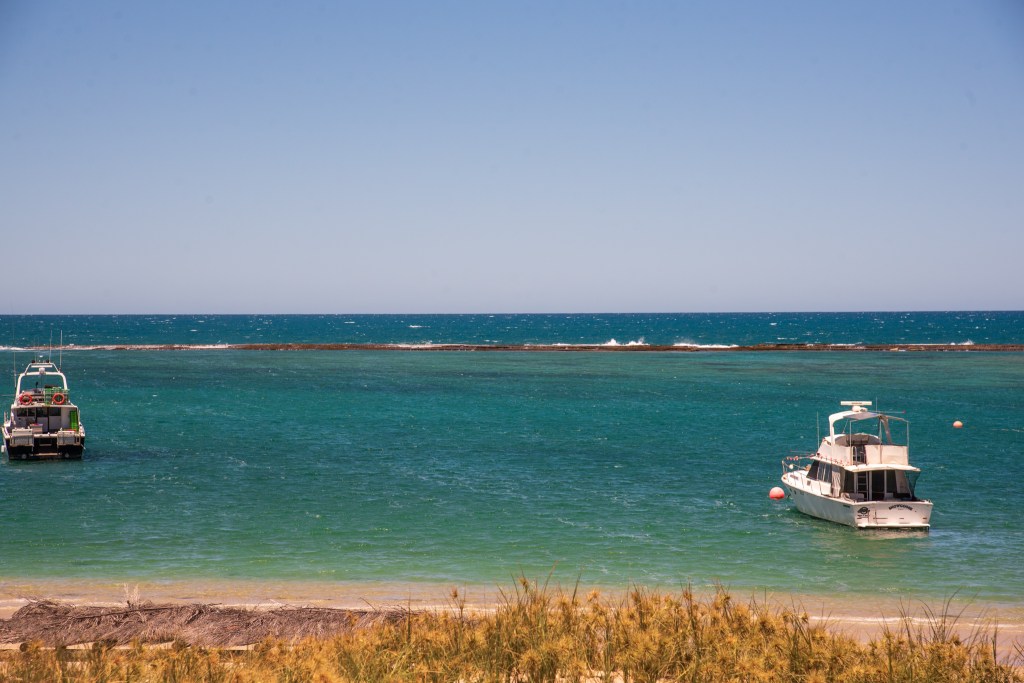
We were up early for our final forty mile passage to Geraldton. Unfortunately the extra lines that Matt had attached to the mooring buoy were all tangled up, so he had to go for an early morning swim to untangle them. Eventually we were free, and cautiously motoring out of the narrow channel, weaving through the fishing boats on moorings and out through the reef to the deeper water.
We were not long out of the channel, when the engine made some ominous spluttering noises and then conked out completely. What the hell?! We looked at each other in confusion. Maybe we are out of diesel? Matt grabbed a fuel jerry and poured some more diesel in, while we also put the headsail out in order to keep moving out to sea and away from land. Thankfully there was enough wind, in the right direction, for us to be able to sail.
Adding diesel didn’t help, so Matt set about trying to work out what the problem was. He changed the secondary fuel filter. No go. He rang a diesel mechanic who suggested checking the fuel pump. Still no go. It was clear we weren’t going to be getting the engine working out here. The prime suspect at this point was a problem with the fuel pump that couldn’t be fixed at sea.
So plan B was to sail the rest of the way. We are in a yacht and sailing is the preferred option. But heading south down the coast of WA in October means you are heading straight into strong southerlies or very, very strong southerlies. Not the best conditions for heading south.
However, at this stage, we were sailing along well, making good time in the right direction. I was just thanking our lucky stars that the motor hadn’t cut out while we were still inside the reef; there was no way we could have safely sailed out through the narrow channel and the surrounding reef.
We discussed our options. At least for now we could keep sailing. We decided that we’d have to anchor outside the marina, try and get a mechanic out to take a look and then move inside the marina when we could. I rang the marina to inform them and the lady told me that VMR (Volunteer Marine Rescue) regularly towed vessels into the marina. No probs, she said. Well, that sounded good to me. I hadn’t really liked the idea of anchoring without a functioning engine. Supposing we dragged and needed to move?
It was about this time that I spotted Sealeaf on our chart plotter. I did a double take, yep, it was them and they were only about 10 miles behind us. I hadn’t expected to see them until much later that day in Geraldton. They must have left Shark Bay earlier than they had planned. We radioed them for a chat and they confirmed that they had given up waiting and just decided to leave. They’d had a very rough passage and were exhausted. We told them about our engine problems and Brian immediately offered for Sealeaf to give us a tow.
Talk about good friends. Here they were, completely exhausted from their own difficult overnight passage and they were offering to delay their arrival in to help us out. We accepted gratefully, but said that for now we were sailing very well and in the right direction. Brian and Sandra agreed to catch up and then stay with us until needed. We sailed steadily for four hours until the winds shifted and we had to start tacking back and forth. Brain called us up on the radio, as he could see us zig zagging on his instruments. ‘How’s about that tow now?’ he asked. We agreed that it was time. If we had to keep tacking our progress would be very slow and we wouldn’t make it to Geraldton before the next strong winds hit. Matt and I set to pulling our sails down, while Sealeaf caught up and prepared a towline off their stern.
Matt went out onto our bow to catch the towline as Sealeaf approached us. Sandra was driving, with Brian standing midships, holding the line to throw to Matt. They were wearing their headsets so they could communicate with each other clearly. Sandra drove Sealeaf up beside us and Brian tried throwing the line over to Matt. Two or three times around they tried, but couldn’t get close enough. The big seas were making it hard.
As Sandra approached us from behind, a big wave would knock Sealeaf off course, straight into us and she’d have to swiftly manoeuvre her over again. It was quite scary standing in the cockpit, with the big motor yacht bearing down on us. It felt like they were going to crash right into us, with Matt even jumping to the other side of the bow. But Sandra and Brian are pros at this and I could see Brian speaking calmly into his mic and Sandra wrestling expertly with the wheel.
After several failed attempts to the throw the towline, the decision was made to float it in front and for Matt to retrieve it out of the water. Sandra drove past us, perfectly positioning the towline, and Matt scooped it up, attaching it to the cleats on our bow. Phew! Hearts beating madly, we all sighed with relief. We were safely on. Now, we just had to sit back and enjoy the ride.
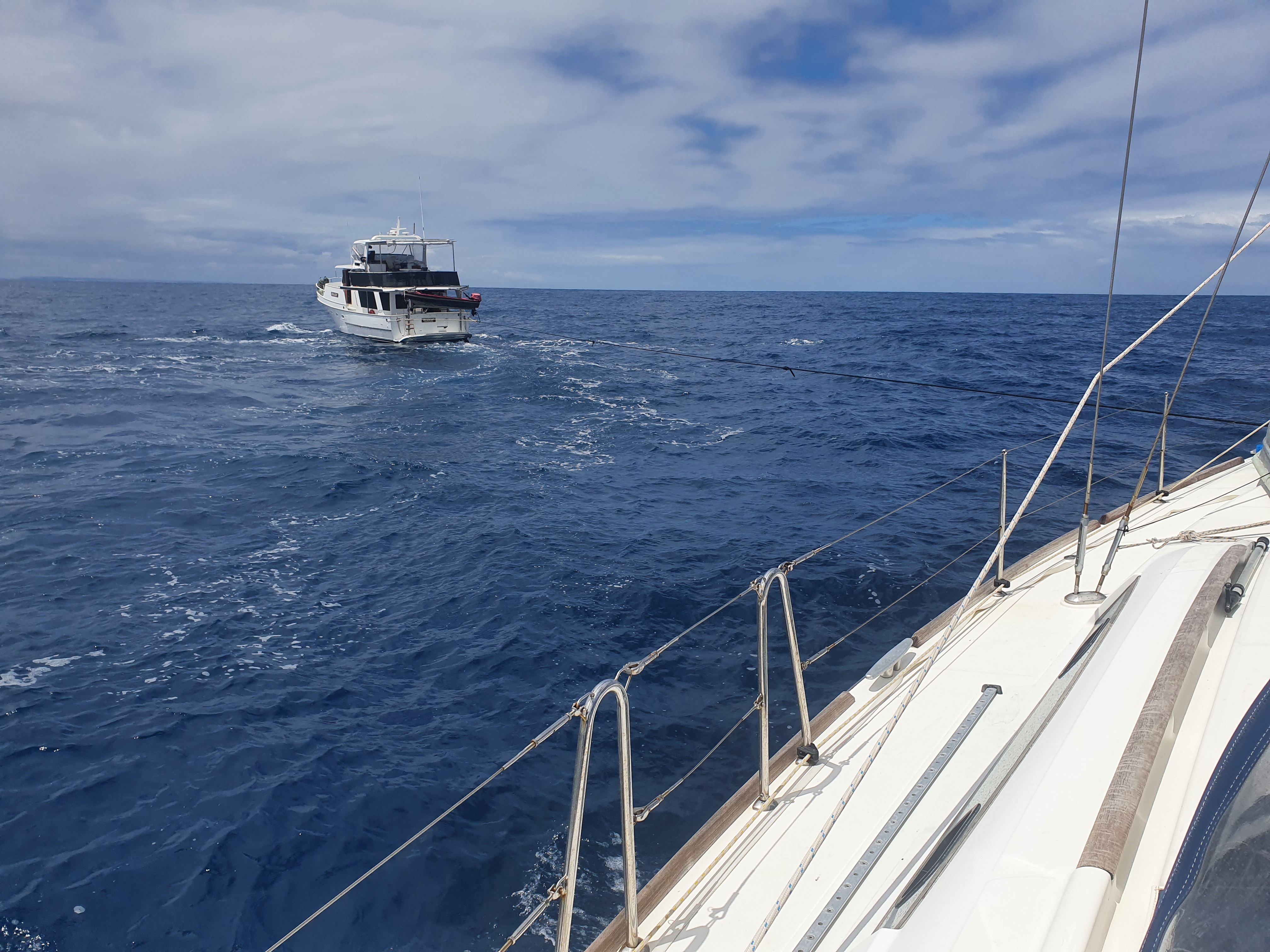
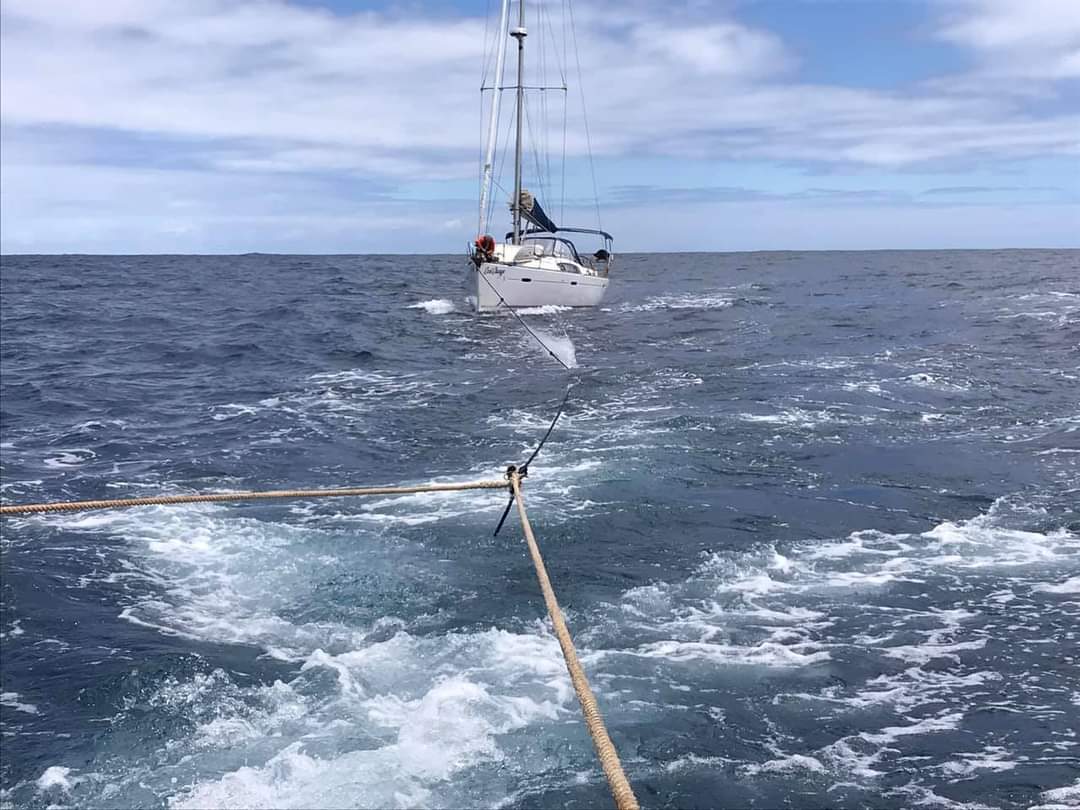
It was another four hours before we were approaching Geraldton and Matt made contact with VMR again. They came out to help guide Sealeaf through the maze of craypots and to let other vessels know that she was under tow. Then, with a confidence and authority that left us feeling very reassured, they attached to the port side of our boat and proceeded to direct operations. As Sealeaf towed us past our berth, we dropped the towline and VMR slowly but skilfully pushed us around and into our berth. I jumped onto the dock to secure our lines and then we were safe. Tied up and secure. We couldn’t thank everyone enough.
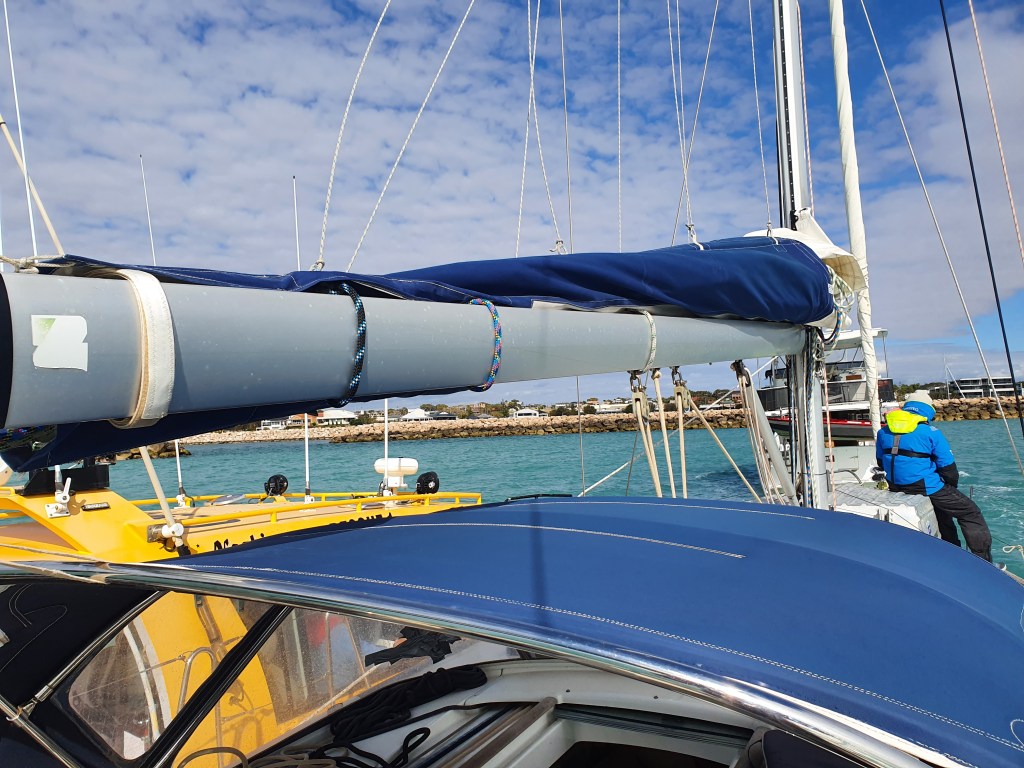
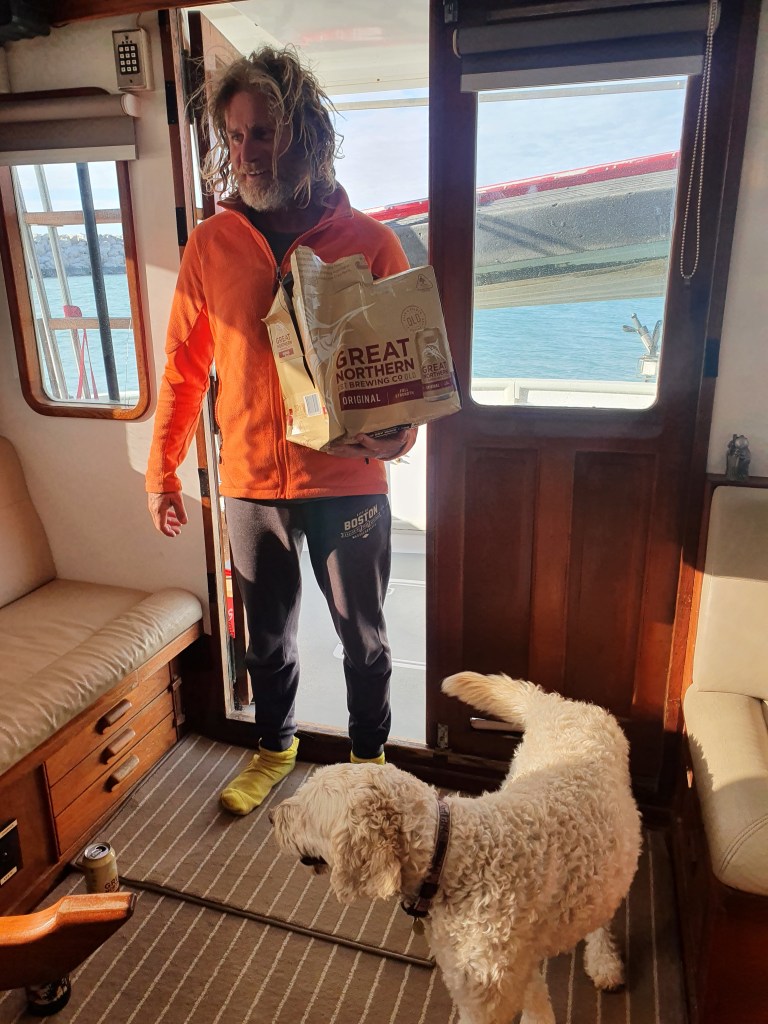
We all had a quick shower and then congregated on Sealeaf. What an adventure! Matt grabbed all the beer that he had left and I ordered pizzas to be delivered to the marina. We flopped and ate and drank and laughed and reminisced. Three cheers for Brian and Sandra! What wonderful friends they are.
We had six nights in Geraldton before the weather let us head south again. And what of our engine? It turned out that the diesel filter had been blocked but when Matt changed it he did not purge the air properly and there was an airlock in the high pressure fuel line. After discussions with a local diesel mechanic and the local Yanmar dealer, he bled the system, purchased a spare fuel filter to have in case of more issues, and the motor was purring again. He cancelled the Yanmar diesel mechanic, but made a note to flush the fuel tank when we stopped in Fremantle.
The primary suspect for the engine drama was low fuel in the tank and the dreaded diesel bug. This is a bio organism that grows in the fuel tanks of yachts and forms a tar like sludge that is know to raise its head when it is least convenient (rough seas and when the tanks are low) and stop engines from working. We would find that out later. But for now, our journey could continue.
Conquering any difficulty always gives one a secret joy, for it means pushing back a boundary line and adding to one’s liberty.
Henri Frederic Amiel
 Cool Change
Wow! What a nerve racking experience, I was enthralled reading about your adventure and mishaps!
LikeLike
Thanks Lesley, lucky all’s well that ends well!
LikeLike