The passage from Port Macquarie to Coffs Harbour is a relatively long one, at 76 nautical miles. We discovered that Trial Bay, located almost exactly halfway between the two ports, is dubbed as one of the coasts best open roadstead anchorages (in the right conditions!). So we decided to break the trip into two shorter days, with a brief stay overnight at Trial Bay.
We had checked and re-checked several different weather sites and the forecast for the following two days looked good. Winds were predicted to be south to southeasterly 15 – 20 knots. Seas were forecast at 1 to 2 metres. Overnight, the wind was predicted to die off and become very light. So not completely benign conditions, but well within our experience and comfort zone, we thought. The shape of Trial Bay meant that we should be somewhat protected from any swell and winds coming from the south. We knew we shouldn’t expect a completely still night, but figured it shouldn’t be too rolly.
We were wrong, so very, very wrong. The next two days and night proved to be some of the most challenging conditions we’d faced on the trip so far. It all started out ok. The bar was calm and flat as we departed Port Macquarie harbour after our breakfast with Amanda and Adam. The sea was pretty lumpy and swelly though, and we mostly motored as the winds were light, rarely more than 10 knots. A few squalls blew over, bringing heavy rain and stronger winds, but they were all fairly brief.
Although I wasn’t comfortable, I managed with my usual tactic of remaining in the cockpit and not going below deck. Thank goodness for those sea sickness pills! About an hour from Trial Bay we spotted heaps of whale spouts but the sea was so rough we didn’t have a good view of their bodies. Then a very active whale started breaching all around our boat. Matt raced to grab his camera and I steered the boat to try and keep up with the whale. We followed him for about half an hour as he continued cartwheeling all over the sea. It was an incredible experience!
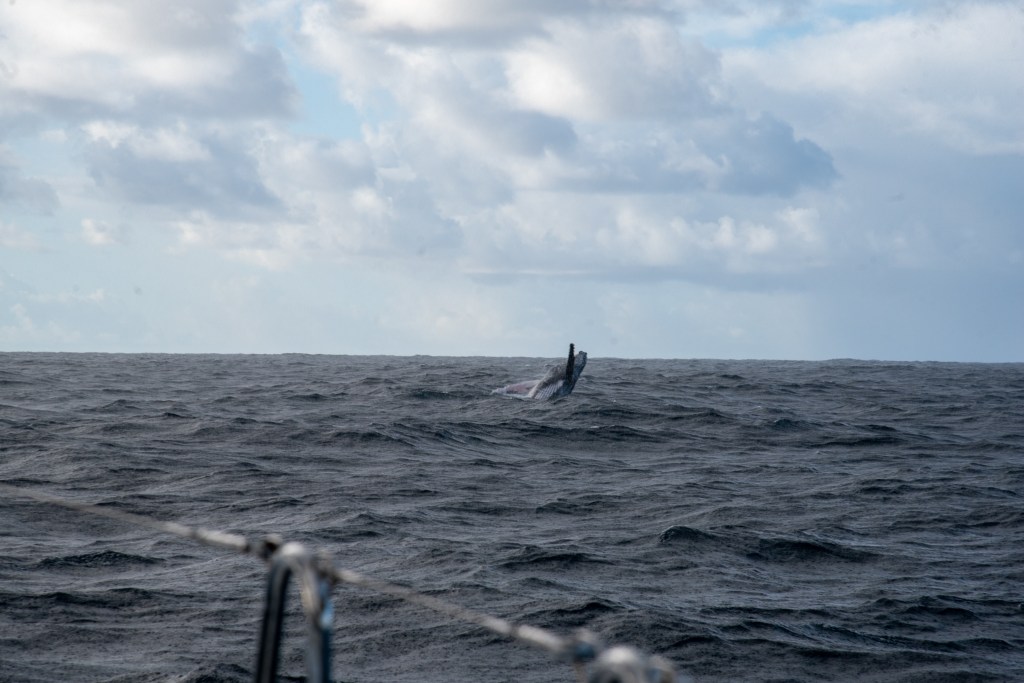
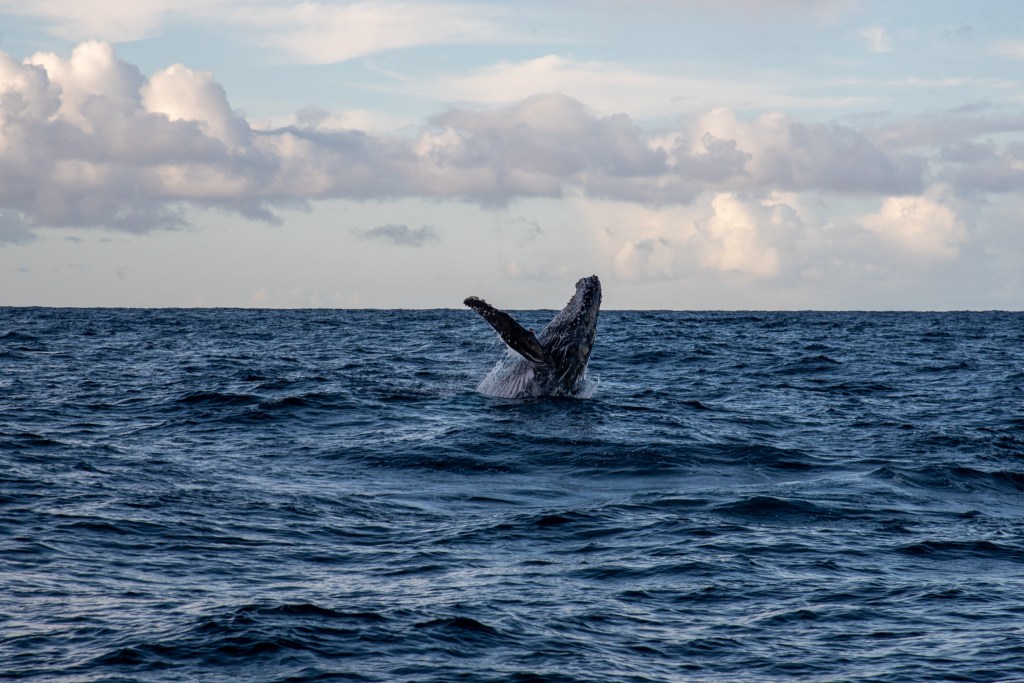
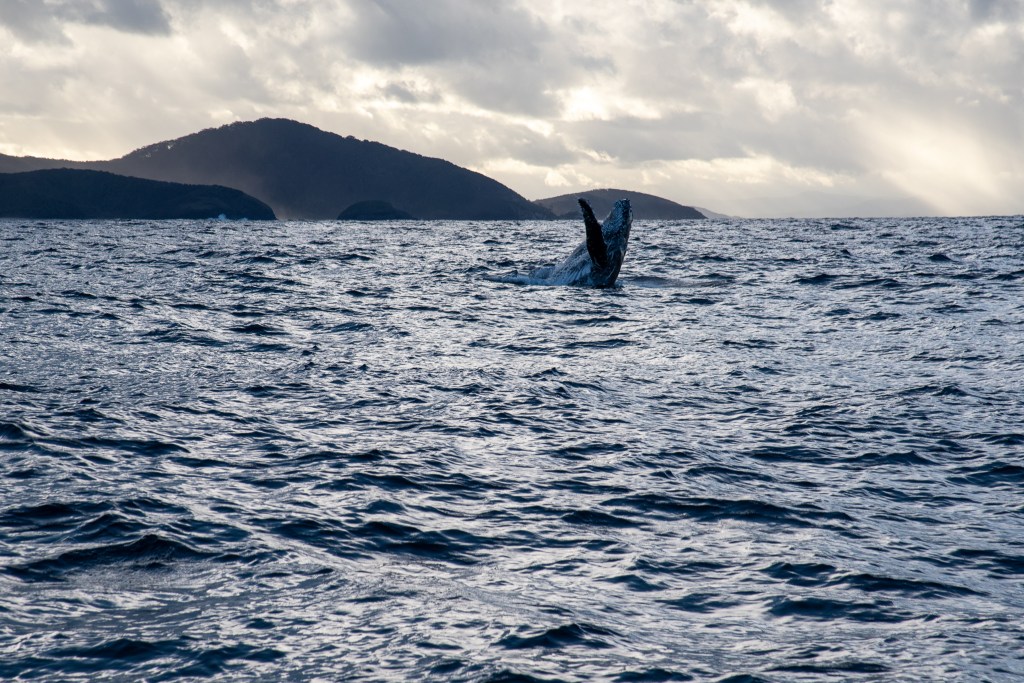
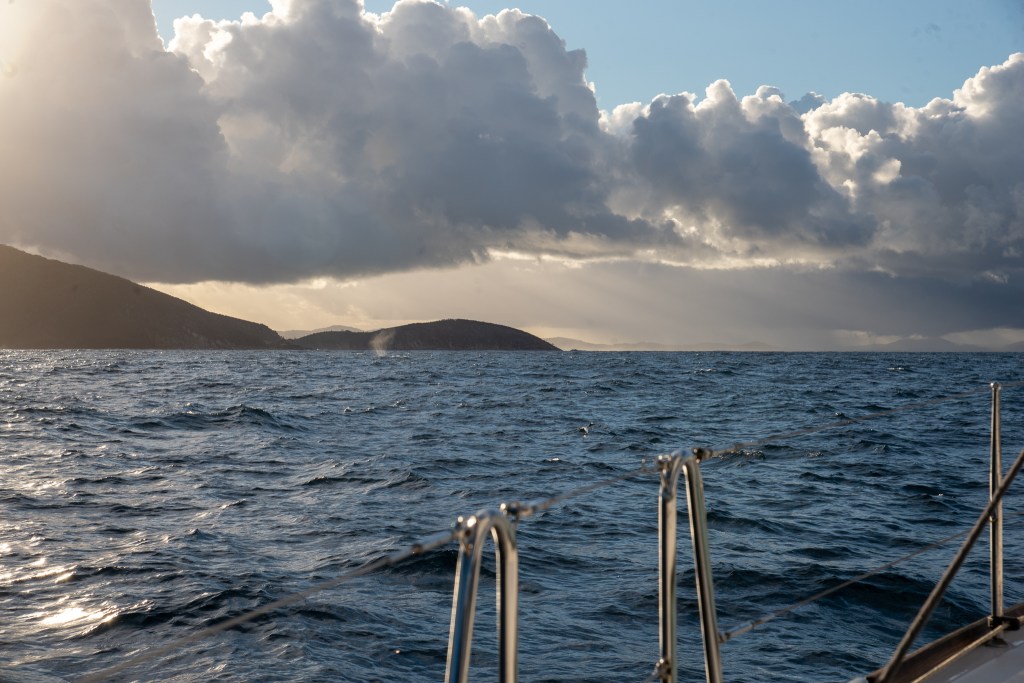
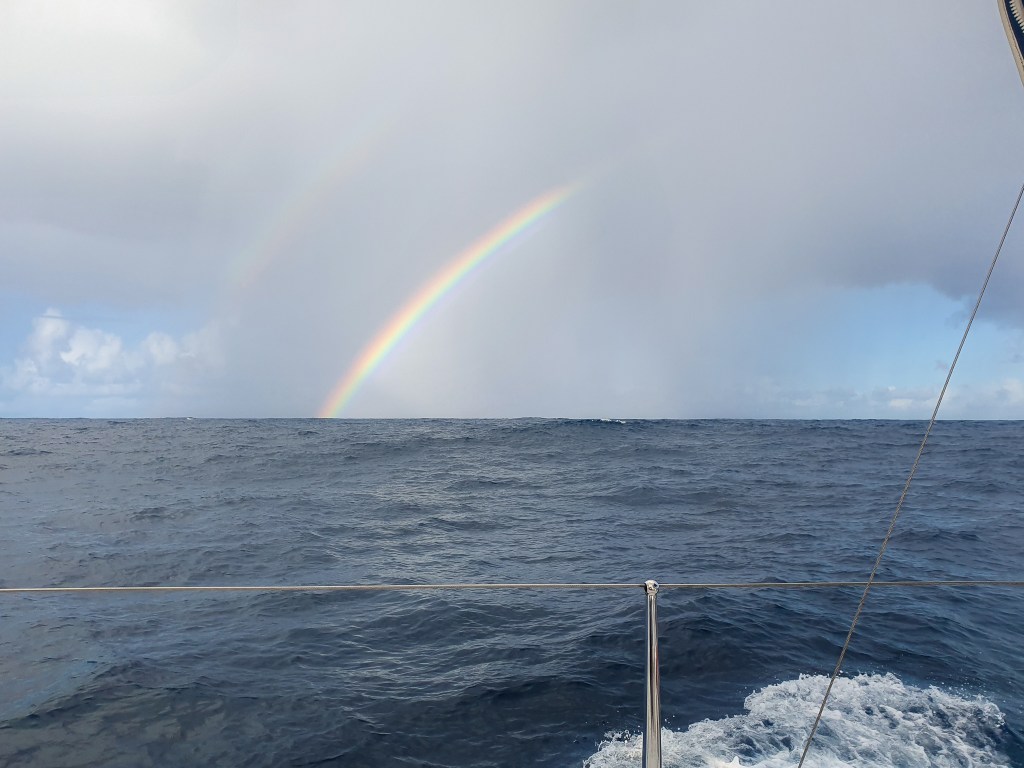
It had been fairly uneventful up to this point, but that was about to change. It was nearing dark as we approached Trial Bay and the wind started to strengthen. A big squall passed over, drenching us. We arrived in Trial Bay with a sense of relief, but that was not to last for long. We had been hoping to tie onto a mooring buoy but after checking with Marine Rescue we discovered that the only mooring in the bay was for Emergency vessels. So we dropped the anchor and Matt attached the snubber line.
The boat has an anchor connected to approximately 50 metres of chain and an additional 50 metres of rope. The anchor windlass is an electric winch that is used to raise and lower the anchor and let out the desired level of chain, which is also called rode. You would normally let out at least 3 times the depth, so if the boat is in 5 metres of water, you would let out at least 15 metres of chain. If unsure, let out more. The windlass is not designed to hold the chain, so a snubber line is attached for this purpose. A snubber line is a piece of rope with a hook that attaches to a link in the anchor chain, while the other end ties to a strong point on the boat called a cleat. More chain is then let out so there is slack between the snubber hook and the windlass. This means that there are four stress points (the anchor in the sea bed, the anchor chain, the snubber hook and line, the cleat on the boat) and there is no load on the winch and it is a secure way of anchoring the boat.
The bay was choppy and the swell was rolling straight on in. The boat was rocking and rolling all over the place. We resigned ourselves to an uncomfortable night without much sleep. We checked and re-checked the forecast. It was still saying that the winds would die down overnight. But what the weather sites were predicting and what was actually happening were two very different scenarios.
Instead of the wind dying down, it strengthened. Throughout the night, squall after squall blew over, bringing heavy rain and fierce winds. Cool Change was lurching and bucking on the anchor. It was a very tense night. We got very little sleep, both of us just lying in bed, anxiously listening to the howling winds rage over, desperately hoping that the anchor would hold.
We were listening to the sounds of the anchor chain crunching and grinding, when all of a sudden there was a huge Bang and then we could hear rode being pulled rapidly through the winch due to the forces of the wind and the swell. Matt threw clothes on and raced up top. He turned on the motor in case it was needed to reposition the boat and hurried to the bow. There he discovered what the bang was. The hook attaching the snubber line to the anchor chain had bent under the force and given way. He raced below deck, grabbed a spare D shackle from the nav station and rigged up a new snubber line.
It was 4 am and we were both wide awake. We decided we’d leave the bay as soon as we could, at first light. Although we went back to bed to wait, there was no need to set an alarm. We set off at 6.30 am into a crazy sea. The sea state was incredibly confused; big swell, three to four metres, with waves in all different directions and strong winds, consistently 20 to 25 knots, at times reaching 30 to 35 knots. ‘This was not the forecast,’ we kept saying to each other.
We had our full wet weather gear on, as well as life jackets and tethers attaching us securely to the boat. There was a lot of rain as well as big waves that would randomly crash over the cockpit, and all over us! The only saving grace was that the water wasn’t freezing cold! We both sat in the cockpit, not talking very much. I had to keep a constant grip on the side of the seat to prevent being thrown off as we rode the swell and lurched over the waves.
I endured. That was the word of the day. Even though I’d had a sea sickness pill I still felt terrible. Matt said I should go downstairs and lie down for a bit, but I knew if I lay down that I wouldn’t be able to get up again, and I didn’t want to leave him on his own out there. I lasted five and a half hours before I vomited. Got my sea legs?! Huh!
It was like being on a rollercoaster that you could not get off. All I wanted was for the movement to just stop. I used every pain management and attention distraction technique I knew; deep breathing exercises, rhythmic tapping. I recited a mantra in my head, over and over, willing it to be true; ‘My body and brain enjoy the motion of sailing.’ It may sound silly, but I tried everything I could think of. Anything to endure. It was a very, very long seven and a half hours.
We discussed our options and were in agreement that the only course was to continue on to Coffs Harbour. Neither of us thought going back to Trial Bay was an option, there would be no respite there. And the conditions would be just as rough heading back to Port Macquarie and since it was the same distance as heading on to Coffs, we might as well keep heading forward. Coffs was also a far easier and safer harbour to enter than Port Macquarie. Importantly, neither of us were feeling scared or worried. We were just very uncomfortable. And I think that shows just how far we’ve come. Even six months ago, I think I would have been absolutely terrified when faced with those conditions. We have trust in the boat and trust in our abilities.
We were however, doubting our ability to interpret the weather forecasts correctly. We listened to the broadcast from Marine Rescue on the VHF radio and the forecast was the same as we’d read online; 20 to 25 knot southerlies and seas of 1 to 2 metres. Nothing at all like what we were experiencing. There wasn’t even a strong wind warning! We heard a fishing trawler call in to Marine Rescue to ask for a weather check; he was just as confused by the contradiction in what he was hearing and experiencing as we were.
But finally, finally we were approaching Coffs Harbour. The biggest sense of relief washed over me when we motored into the shelter of Coffs Harbour Marina. The strong wind made berthing tricky, but some other yachties came out to help, grabbed our lines and helped us to tie up. The yachting community is a really lovely bunch of people.
We’d briefly met Ian and Lynne from Meltemi in Pittwater. They’d been planning on leaving Coffs that day, but had woken, taken one look at the weather and decided to postpone their departure. Paul and Liz, from Amaranth, had followed us up the coast the previous day and seen us pull into Trial Bay. They’d continued motoring and arrived at Coffs Harbour at 9.30 pm, a good choice. They’d been wondering how we’d fared. We discussed the bizarre weather forecast. To our relief we hadn’t stuffed up and the others had been caught out by it too. Ian described that weather forecast as the most inaccurate predictions they’d encountered in their three years of travelling on their boat.
Matt and I both felt really proud of ourselves and of each other. Proud of how we’d coped and proud of how we’d worked as a team and supported each other. We sure are on a huge learning curve, but we are doing the best we can, and we are doing it together.
Later that day we ran into Chris and Anne from the yacht Horizons. Matt had met them in Forster-Tuncurry and they’d moored next to us briefly in Port Macquarie. They had left Port Mac a few days before us, and also stopped at Trial Bay on the way up to Coffs, only they had a couple of idyllic days in the bay. Sometimes it’s just luck of the draw!

At the end of the day, we can endure much more than we think we can.
Frida Kahlo
 Cool Change
Well done getting to Coffs safely Matt and Lisa . Comments – NSW coastal weather is very unpredictable as we have found many times , so don’t trust the forecast . Try not to anchor in unprotected anchorages , assume that winds will be 40% stronger than forecast . Use 5 times your depth as anchor chain length not 3 . Your snubber hook must be cast not malleable . From someone who has been in exactly similar circumstances . Unfortunately you need to experience these downers to become safe sailors . Well done !
LikeLike
Cheers Rog. My motto is, If in doubt let more out. We had a lot out that night. Have since upgraded snubber line and hook. I asked for one rated to stop a tank.
LikeLike
Re my new gooseneck , around $350 sl différent design but easy to fit . Cheers and safe sailing . Roger
LikeLike
Did you purchase a Mede up snubberk Matt. If so can I have the details as I am making a new one . CheersRoger
LikeLike
No. I got a winchard snubber hook and 6m of nylon 3 strand with an eyelet on each end. I tie off to each front cleat and the snubber hook slides along the nylon. I sent you pics on fb
LikeLike